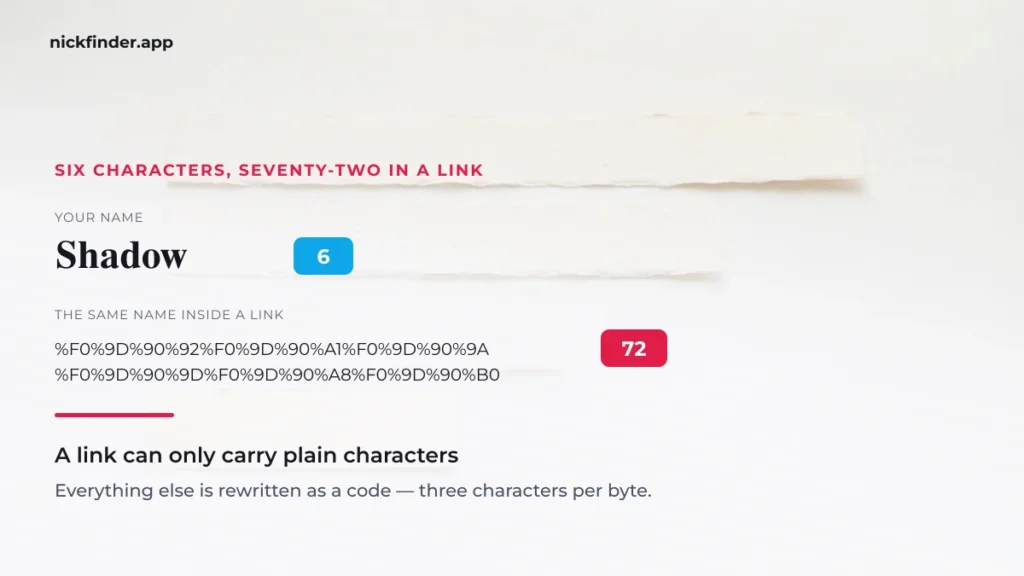
Your nickname is six characters. Put it in a share link and it can become seventy-two. Nothing was added — a link can only carry a small set of plain characters, so everything else gets rewritten into a code, and styled letters are the most expensive thing you can put in one.
Why a link cannot hold your name as-is
A web address is allowed to contain letters, digits and a handful of punctuation marks. Anything else — an accent, a symbol, an emoji, a styled letter — has to be written as a code: a percent sign followed by two digits, once for every byte the character occupies.
Plain English letters are one byte each, so they pass through untouched. A bold letter from the styled block is four bytes, which becomes twelve characters of code. Six of them is seventy-two.
The same name, twelve ways
| Name | Characters | In a link | Times longer |
|---|---|---|---|
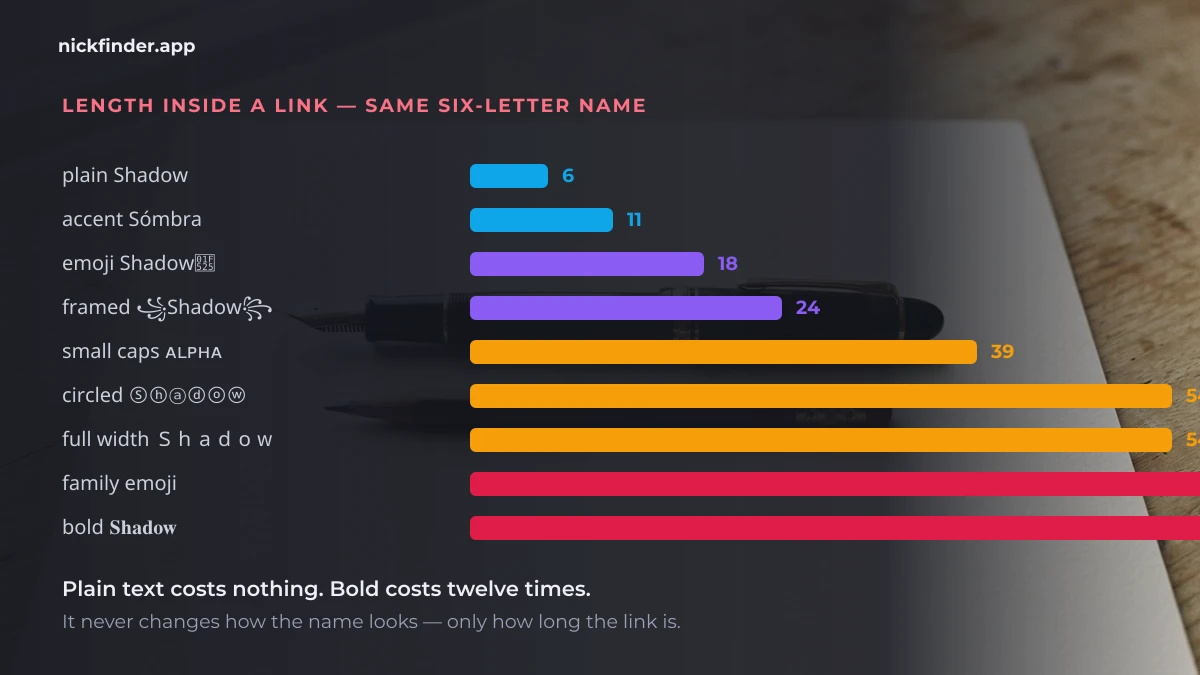
| 𝐒𝐡𝐚𝐝𝐨𝐰 bold | 6 | 72 | ×12.0 |
| 影 CJK | 1 | 9 | ×9.0 |
| Shadow full width | 6 | 54 | ×9.0 |
| Ⓢⓗⓐⓓⓞⓦ circled | 6 | 54 | ×9.0 |
| ᴀʟᴘʜᴀ small caps | 5 | 39 | ×7.8 |
| Shadow👨👩👧 family emoji | 11 | 60 | ×5.5 |
| ꧁Shadow꧂ framed | 8 | 24 | ×3.0 |
| عليShadow arabic | 9 | 24 | ×2.7 |
| Shadow🔥 emoji | 7 | 18 | ×2.6 |
| Sómbra accented | 6 | 11 | ×1.8 |
| Shadow trailing space | 7 | 9 | ×1.3 |
| Shadow plain | 6 | 6 | ×1.0 |
Read the last column. Plain text costs nothing. An accent nearly doubles. Small caps is almost eight times. Bold is twelve times.
Where this actually bites
- Share links. Some apps cut a link after a set length, and the cut lands in the middle of a code.
- QR codes. More characters means a denser code that needs a steadier camera.
- Messages with a character limit. The link counts as its encoded length, not its visible one.
- Old forms and search boxes. A few still cap the address length and simply drop the rest.
None of this affects the name itself — it looks exactly the same everywhere. It only matters at the moment your name travels inside an address.
Plain names — no cost at all
The number on each chip is characters, then length inside a link. Plain ASCII passes through a link untouched, one character in and one character out, so this is the only group where the number you count is the number that travels.
Small caps — around eight times
Small caps are not ordinary letters shrunk down — each one is a separate character three bytes wide. ꜱʜᴀᴅᴏᴡ is six characters but seventeen bytes, so a link carries it as fifty-one characters: 8.5 times the plain spelling, for a name that reads almost identically on screen.
Bold — twelve times
The most expensive style there is. Beautiful in a profile, enormous in a link. Six bold letters are 24 bytes, which a link writes as 72 characters — the same length as a whole sentence of plain text, for a name that occupies six visible slots.
Symbols — three characters each
Most decorative symbols are three bytes, so each costs nine characters in a link. Still far cheaper than a styled letter.
Kaomoji
Kaomoji are built from ordinary punctuation plus a few symbol characters, so they encode like symbols rather than like styled letters. (◕‿◕) is five characters and thirty-three inside a link; ʕ•ᴥ•ʔ is thirty-nine. Cheaper per character than bold, but they start out long, so the total lands in the same place.
Emoji
An ordinary emoji is four bytes — twelve characters encoded. A joined one is several of those in a row.
What to do
- Keep the plain version of your name somewhere. Use it when a link is involved and the styled one everywhere else.
- If a share link gets cut, shorten the name, not the link. The length is coming from the name.
- Symbols are cheaper than styled letters. One star costs nine; one bold letter costs twelve.
- Test by pasting the finished link somewhere with a length limit. That is the only measurement that matters.
Community kaomoji bank
100 faces from the shared library — tap any one to copy. Invisible formatting characters and right-to-left characters have been filtered out, since both break names in ways you cannot see.
Community nickname bank
155 nicknames submitted and copied most often by readers across the network.
Frequently asked questions
Does this change my nickname?
No. The encoding exists only inside the address. What people see is unchanged.
Why does bold cost so much more than an accent?
Because an accented letter is two bytes and a bold letter is four. Every byte becomes three characters of code.
Is a shortened link a fix?
Yes, for sharing. The long address still exists behind it, but what you send is short.
Why do some links show my name readably?
Because many browsers display the decoded form while sending the encoded one. What you see in the bar is not what travels.
Do spaces count?
Yes, a space becomes three characters. It is the cheapest thing on this page to remove.
Which style is the best compromise?
Small caps: it still reads as styled, and it costs about two thirds of what bold does.
- 1 Why a link cannot hold your name as-is
- 2 The same name, twelve ways
- 3 Where this actually bites
- 4 Plain names — no cost at all
- 5 Small caps — around eight times
- 6 Bold — twelve times
- 7 Symbols — three characters each
- 8 Kaomoji
- 9 Emoji
- 10 What to do
- 11 Community kaomoji bank
- 12 Community nickname bank
- 13 Frequently asked questions